Old House Roofing · Blog
Roof cleaning in Jenkintown - black streaks, moss and when a stained roof needs replacing
Dark streaks and green patches are common on the older roofs of Jenkintown, PA, where mature trees shade close-set houses. Most of it is cosmetic, some of it shortens a roof's life, and the wrong cleaning method does more harm than either. Here is how to tell which you have and what to do about it.
- Jenkintown Borough, 19046
- Clean, wait or replace
Most streaks and moss on a Jenkintown roof call for gentle cleaning and more sunlight, not a new roof. Black streaks are usually algae and mostly cosmetic. Moss holds water and can shorten a shingle's life. Replacement makes sense only when the shingles themselves are failing: bare, curling, cracked or leaking.
What the black streaks actually are
The Asphalt Roofing Manufacturers Association (ARMA) says the brown-to-black discoloration seen on roofs across the U.S. and Canada is usually algae, with Gloeocapsa magma the most common species. The spores travel through the air and settle on roofs and other outdoor surfaces, and the dark color comes from the algae's natural pigments. It can look like soot, dirt or tree droppings, and it may cover a slope evenly or run in streaks. It is most visible on light-colored shingles and least visible on dark ones.
ARMA places the problem along the Eastern Seaboard, among other regions, and links it to warm, humid conditions. Jenkintown gets plenty of wet days: NOAA's 1991 to 2020 normals for Philadelphia International Airport, the nearest long-record station, count about 121 days a year with measurable precipitation.
Moss and lichen are not the same thing
Moss is a plant that roots into debris and the gaps between shingles. Oregon State University Extension says moist, shady roofs are ideal for it, that over time it slows or blocks water flowing off the roof, and that it can contribute to shingle damage. Its advice is that moss can shorten a roof's life and is cheaper to deal with early.
Lichen, the flat, crusty gray-green or orange patches, looks similar but behaves differently. The same Extension page says lichens grow more slowly than moss and do not contribute to shingle damage the way moss does, and that they can usually be left alone. If the only growth on your roof is lichen, there is little reason to scrub at it.
Why older Jenkintown roofs get it
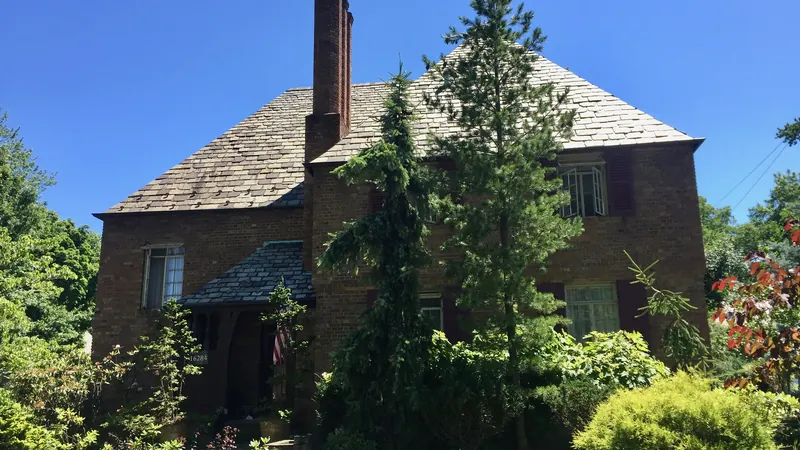
Shade and moisture do most of the work. A slope that faces north, sits under a large tree or is overhung by a neighbor's roof dries slowly after rain and collects leaves, and that is where moss starts. Census estimates for ZIP 19046 put the median year built at 1954, and about half the area's housing units are detached single-family houses; roughly 30 percent are in buildings with five or more units. Older houses on mature, tree-lined streets are exactly where shaded, debris-holding roof slopes are common. If you live in a multi-unit building or a condominium, roof cleaning and tree work usually go through the association rather than an individual owner.
How to clean asphalt shingles without damaging them
ARMA's guidance is specific, and it is mostly about what not to do:
- No pressure washer, brush or broom. ARMA says high-pressure washing is likely to damage asphalt roofing and should not be used on it for any purpose, and that scrubbing loosens the granules that protect the shingle.
- A bleach-and-water solution can lighten algae. ARMA says a solution of household liquid bleach and water can lighten the discoloration, but that mixing directions vary by shingle manufacturer, and other chemicals should not be used without the manufacturer's approval. Check your shingle maker's instructions first.
- Apply gently, wait, rinse gently. Spray the solution on lightly, leave it for at least 15 but no more than 20 minutes, then rinse with a gentle spray of water.
- Protect the yard and the house. Bleach can harm plantings and other parts of the building, so wet down or cover what is below and keep runoff away from it.
- Stay off a wet roof. ARMA warns the process makes the roof slippery and encourages using professionals. Work from a ladder or walkboards where possible.
The cleaning is temporary. ARMA says algae discoloration may come back, so a clean roof in spring can streak again within a few years.
For moss, Oregon State University Extension recommends removing it physically, by scraping or brushing it off gently, and notes that moss killers kill the growth but do not remove it or prevent regrowth; the dead moss still has to come off. After that, an annual routine of clearing leaves and debris before rain keeps it from returning.
Trees: the fix that lasts, and the Borough's rules
The most effective prevention, per the same Extension guidance, is less shade: remove or thin the branches that hang over the roof. In Jenkintown that can involve the Borough. The Borough's tree ordinance, Chapter 167, defines a shade tree to include any part of a tree that extends within the lines of a public street, and section 167-3 requires a written Borough permit to plant or remove trees in the public right-of-way. The Borough's tree permit application covers pruning of right-of-way trees as well as planting and removal. Section 167-5 separately requires owners to keep branches over a sidewalk at least 9 feet up and over a street at least 16 feet up.
So if the limb shading your roof belongs to a street tree, or reaches over the sidewalk, ask the Borough before anyone cuts it. A tree wholly on your own lot is your call, though a tree service should still check where the trunk and canopy sit.
When staining means it is time for a new roof
Discoloration alone is not a reason to replace a roof. These are:
- Bare patches where the granules have washed away and the black asphalt shows.
- Shingles that curl, cup, crack or have lost tabs.
- Soft spots underfoot (seen by a roofer, not tested by you) or sagging between rafters.
- Leaks, or water stains on the attic boards under the stained area.
- A roof that is already near the end of its expected life.
If the roof does need replacing, ARMA notes that algae-resistant shingles are made specifically to inhibit algae growth for extended periods, which is worth asking about on a shaded Jenkintown lot. Our page on roof replacement in Jenkintown covers the Borough permit, and 3-tab vs. architectural shingles covers the choice of shingle.
If the stained roof is slate, the cleaning advice above does not apply. Slate has its own care, and a slate specialist is the right person to ask; our guide on whether to fix or replace a slate roof explains when a slate roof is worth keeping.
Not sure whether you are looking at algae, moss or a worn-out roof? Send the form with a photo note and the age of the roof. We will tell you in writing whether it needs cleaning, a closer look or replacement.
Quick answers
Are black streaks on my Jenkintown roof a sign it is failing?
Can I pressure wash my roof to get the moss off?
Do I need Borough permission to cut back a tree over my roof in Jenkintown?
Do zinc strips stop moss on a roof?
Sources
- Asphalt Roofing Manufacturers Association, Technical Bulletin, Algae Discoloration of Roofs (revised June 2024), accessed Nov 21, 2026
- Oregon State University Extension, Solve Pest Problems, Moss on Roofs and Walkways (updated May 28, 2026), accessed Nov 21, 2026
- Borough of Jenkintown Code, Chapter 167 Trees (sections 167-1, 167-3 and 167-5), eCode360, accessed Nov 21, 2026
- Jenkintown Borough, Application for Permit to Plant, Remove, or Prune Trees (public right-of-way), accessed Nov 21, 2026
- U.S. Census Bureau, ACS 2020-2024 5-year, tables B25024 and B25035, ZCTA 19046, read through Census Reporter, accessed Nov 21, 2026
- NOAA NCEI, U.S. Climate Normals 1991-2020, annual normals for Philadelphia International Airport (USW00013739), days with measurable precipitation, accessed Nov 21, 2026
Last checked 2026-10-29.
Rules change. Confirm with the city, township or borough permit office before you rely on any permit or historic-district detail here.
Ask for a free roof inspection in Jenkintown
Tell us where the house is, how old the roof is and what it is doing. If you have photos, say so and we will ask for them by email. Outside our core area? Send the form and ask.
We answer form requests Monday to Friday, 9am to 5pm. There is no phone line, so the whole conversation stays in writing.